Showing posts with label watubi. Show all posts

Wednesday, April 4, 2018

The Rise and Fall of Old Lady Hawkins


* Ongoing Update© 1965-1980 Powered by Kupaki Company™ 
and © 2012-2018 KUPA- Bagumba™. All Rights Reserved. 


By the 1970s Old Lady Hawkins lived in a typical suburban neighborhood, playing the role of a socially conscious homemaker. Her loved ones did not know about her real business activities; it would be easy to assume she simply spent her days managing her small pet shop that she owned and attending town hall meetings. 


However, despite outward appearances, Mrs. Hawkins was a major drug kingpin initially affiliated with the Indigo Mob Cartel, secretly using her business as a legitimate cover for her Captivora berry and Trigonella berry distribution throughout North America Including Hawaii and the Southern Pacific Islands. Like the rest of the Indigo Mob, Old Lady Hawkins was a criminal who "hid in plain sight"; using her anti-drug philanthropy to conceal her true nature and build her illicit drug empire step by step. 

...The Rise and fall of Old Lady Hawkins. 


************************************************


Early Life 


Old Lady Hawkins was born in a small town in the Midwest. She and her mother moved to Los Angeles in 1916 when she was three years old. Hawkins had become a pickpocket before she even turned 13 to finance her escape from all of the “abuse” from her “mean mother” who actually had the audacity to expect her to stay in school, get good grades, go to church and make an honest living for herself, Hawkins ran away to Hawaii from home at the age of 14 and resorted to looting in Pearl Harbor until the age of 20.  It didn't take long for Hawkins to begin living a life of crime. In 1930 Hawkins allegedly kidnapped, and attempted to ransom a family from an upscale neighborhood near her own neighborhood. 

Old Lady Hawkins with one of the carrier pigeons 
Hawkins former lover known only as “Lucky” was part of the notorious gang, the Indigo Mob recruited her at the age of 20, and it was then that Hawkins crime spree really began. She first started working behind the scenes as a money launderer for the Indigo Mob but then led the cartel after the arrest of her lover Lucky. Since most of the Indigo Mob had become either arrested or killed, 


Hawkins former lover
known only as “Lucky”
who was part the Indigo Mob
Old Lady Hawkins began to manage the financial aspect of the organization, overseeing alliances, and taking the lead of the Indigo Mob. By utilizing her historical contacts with drug suppliers and politicians in Equarico she managed to keep the organization afloat. 


************************************************


The Drug Business 


Old Lady Hawkins was a major figure in the history of the drug trade from Nicaragua, Equarico and Colombia to Miami, Florida, and other states across the United States. 

In the mid-1950s, Old Lady Hawkins and her second husband Norbert Wiley moved back to California, settling in the city that was familiar to her, Los Angeles, California. They established a sizable cocaine business there, and in April 1955 Hawkins was indicted on federal drug conspiracy charges along with 30 of her subordinates. She fled to Equarico before she could be arrested, while in Equarico it bought her the necessary time to establish a foolproof plan by using her political leverage and influence that would ultimately remove all of the charges against her. This allowed her to return to the US free and clear, this time settling in Hawaii in the early 1960's. 


************************************************


Hawaiian Drug Wars 


Hawkins return to the Hawaii from Equarico more or less coincided with the beginning of very public violent conflicts that involved hundreds of murders and killings which were associated with the high crime epidemic that swept the City of Honolulu in the 1960's. Law enforcement's struggle to put an end to the influx of heroin and cocaine into Honolulu led to the creation of CENTAC 24 (Central Tactical Unit), a joint operation between Honolulu Police Department and the U.S. Department of Justice, anti-drug operation. 

Hawkins was involved in the drug-related violence know as the Island Drug War aka the Cocaine Cannibal Wars that plagued Honolulu in the mid-1960's. This was a time when cocaine superseded marijuana trafficking. It was the lawless and corrupt atmosphere, primarily created by Old Lady Hawkins operations which led to the gangsters being dubbed the "Cocaine Cannibals" and their violent way of doing business as the as the "Island drug war". It was at this time where Hawkins got her nickname as the "Old Lady" since she was the matriarch and most experienced gang member. 

Her distribution network, which spanned the United States, brought in $80,000,000 in US dollars per month. Her violent business style brought government scrutiny to the islands of Hawaii leading to the demise of her organization and the free-wheeling, high-profile Honolulu drug scene of those times. 


President Rodriguez
It is also alleged that Hawkins backed the October 1965 storming of the Tower of Justice, the building that houses the Supreme Court of Equarico (a tiny unstable Latin American country located near the coast of Chile) by left-wing guerrillas from the terrorist organization, ‘Brown November Group’, also known as B-11 Group. The siege, which was done in retaliation for the Supreme Court studying the constitutionality of Equarico’s extradition treaty with the U.S., that resulted in the
exile of President Pancho Hernando Gonzalez Enriques Rodriguez of the Republic of Equarico. The B-11 Group demanded that President Rodriguez be returned from exile. B-11 were paid by Hawkins to break into the Tower of Justice and burn all papers and files on President Rodriguez — and his “special cabinet” which was a group of trigonella berry smugglers who were under threat of being extradited to the U.S. by the Equaricoian government. Old lady Hawkins was listed as a part of The Brown November Group. 


Hostages were also taken for negotiation of their release, thus helping to prevent extradition of Rodriguez’s special cabinet to the U.S. for their crimes. In addition they demanded the safe return to power of President Rodriguez who only two weeks earlier on September 30, 1965 had been exiled on a small island in the Bagumba Island Chain. However several days after Rodriguez’s return to power in Equarico, the Equaricoian Senate initiated a vote of no confidence which set in motion a ‘counter-counter’ revolution because it was determined that Rodriguez was delusional due to his claims about being the dictator of the little island where he was exiled. Therefore Rodriguez was permanently exiled to the Andes Mountains and of course Old Lady Hawkins wasted no time signing on with Equarico’s new corrupt, unscrupulous regime.


************************************************


The Drug Wars Continue As Birdy Enters The Picture


It is a known fact that Old Lady Hawkins and Birdy met in Hawaii in early 1960. Several accounts describe Hawkins and Birdy's first meeting, but the most credible tells that Old Lady Hawkins met Birdy on March 5, 1960, at the home of Birdy's friend Boris Knuckley, a two bit conman from Boston. Boris had a rundown house at 409 Caldwell Ave, in Lanai City Hawaii. Hawkins was out of work and staying with Knuckley to assist him with several ‘Lottery fraud by proxy scams’ in town. 


There was an instant connection between Birdy and Mrs. Hawkins. At the time Old Lady Hawkins was 47 and still married to Norbert Wiley; but Wiley was in Leavenworth at the time finishing a three year stint for armed robbery. Birdy was 49 and unmarried. When they met, both were immediately enamored with each other; some said that Hawkins joined Birdy because she was in love. But the truth was that the only thing that Hawkins was in love with was money. In reality the only reason Old Lady Hawkins involved herself with Birdy in the first place was she realized how intelligent and poised he was and she desperately needed someone in her organization who used their brain and wasn't so incompetent like most of the thugs that she was used to. The fact of the mater was Birdy was self disciplined, efficient and extremely meticulous. In addition to being a good business man, he was skilled and well-organized  scientist, with an estimated IQ of 170. 

Birdy didn't exactly spark images of genius, but it should have because Birdy was a resourceful and calculating criminal. Some believe that Birdy was the actual mastermind behind the couple's reign of terror, but the truth was it was Old Lady Hawkins that called the shots since the beginning. Hawkins remained Birdy's loyal companion as they carried out their crime spree. Some speculated that their relationship was more that just business, but there was never any proof to back up that alleged theory.


************************************************


************************************************


But Who Exactly Was Birdy?


Prisoner 4115-SS was an inmate at the Song Song State Penitentiary in Hawaii, Through his entire life nobody knew his real name,


There was no record of Birdy's existence
he was never legally identified and there was absolutely no record of his existence. He was known only as “Birdy,” a name he acquired because he collected and raised homing pigeons on the roof of the prison. During the time he was at Song Song Birdy was the behind the scenes leader of the Indigo Mob in Hawaii, which controlled the drug trade for the entire West coast of the United States and all of the Islands in the Pacific Ocean .

Birdy began serving a 7 year sentence in solitary confinement at Song Song Prison Hawaii,  where in 1950, after discovering a nest with three injured pigeons in the prison yard, he began raising them, and within a few years had acquired a collection of some 300 pigeons. He began extensive research into them after being granted equipment by a radical prison-reforming warden, publishing ‘Homing Pigeons' and Their Navigation Abilities, in 1953, which was smuggled out of Song Song and sold en masse, as well as a later edition (1955). 


Birdy's Transfer Orders from Song Song Prison to Alcatraz
Birdy made important contributions to avian pathology, most notably a cure for the Avian variety of Roomis-Igloomis family of diseases, gaining much respect and some level of sympathy among ornithologists and farmers. Birdy ran a successful business from inside prison, but his activities infuriated the prison staff, and he was eventually transferred to Alcatraz in 1955 after it was discovered that Birdy had been secretly making LSD using some of the equipment in his cell. 


From the late 1950s to early 60's, Birdy was reportedly making more than $1,000 a day in profits from drug sales. In 1963 while in Topeka Kansas he was arrested after being infiltrated by an opposing mobster named Jackson Farrell who was a professional criminal on the run from the police for bank robberies. Jackson  Farrell made a deal with the Topeka police department and U.S. Marshals to exonerate himself of all crimes if he could provide enough evidence that would lead to a conviction of Birdy. 

When the the deal with Jackson Farrell was cemented with the Topeka police and the Marshals, an All Points  Bulletin was issued nationwide to locate and arrest Birdy. Finding Birdy was much harder than expected and for months Birdy seemed to elude arrest. Finley a reward of 1 Zillion dollars in gold was issued for information leading to the apprehension of Birdy, dead or alive. 


The bait worked because on March 25th of 1963 Birdy was caught when a group of local surfers told officials that they saw a strange man on a makeshift bamboo surfboard/raft that fit Birdy's description. When interviewed by police one of the surfers, Duke Williams said that when they approached the man to see if he needed help the man kept yelling "you can't catch me", "you'll  never lock me up again". Mr. Williams said that it was obvious that the man didn't belong there, "the guy didn't even have the right type of surfboard for the massive waves that were in that area of beach!!"

Mr. Williams and a few of the other surfers took it upon themselves to tow the man (Birdy) back to shore because not only did he fit the description of the fugitive, but had he stayed out there much longer on his odd surfboard, it was only a matter of time before he would have drowned. When they got him to shore the local authorities were contacted and Birdy was taken into custody. 

The Honolulu police chief said in a statement that "The suspect (Birdy) was attempting to escape the closing dragnet that was all around him, so in a panic he decided to leave Hawaii in an attempt to row out to sea and find some deserted island that he knew about and meet up with his colleagues". the police chief went on to say, "There is no question that Mr. Birdy would have failed to make it to his island destination". "More that likely he would have drowned, died from from exposure, or have be eaten by sharks".


It's pretty much certain that had it not been for the group of surfers that were in the area where Mr. Birdy was, there would have been a very different outcome. Despite the fact that Birdy was a fugitive, the group of surfers should be considered heroes. When asked about that notion surfer Duke Williams replied, "Hey man we were just in the right place at the right time, ...I mean what was that guy thinking? Did he really think that he could make it?" "Did he just think that some magical backwards wave come by, swoop him up and give him a ride to his secret island?" "What a dope!"


Birdy Takes On A New Roll In The Organization After His Incarceration 


News of "Birdy's" untimely arrest made national headings in  May of 1963 
On March 30, 1963 only three years after meeting each other, Birdy was arrested on international drug  trafficking charges and ten days later was sentenced to 150 to 200 years in prison. While behind bars nothing much changed, it eventually came to light that Birdy was still running his crime syndicate.


Then on April 3, 1967 after only four years in prison the sentence was exonerated when facts came to light that a government informant was giving false information and lying under oath. He was discharged the very same day but right before he exited the prison Birdy decided to set loose his pigeon friends as well. The next day he rejoined Old Lady Hawkins, and resumed his life of crime.


 Birdy being transported to Song Song Prison by the DEA in 1963


On April 3, 1967 after only four years in prison Birdy's sentence was exonerated On the very
same day Birdy decided to set loose his pigeon friends right before he exited the prison. 


Prison life did not agree with Birdy but while there
his loyalty to Old Lady Hawkins never faltered.
In 1975, after a five-year undercover investigation by the federal government, Birdy was indicted on drug conspiracy charges. In 1977, he was found guilty of all charges and sentenced to six life sentences. Birdy is currently back at his old prison, Song Song serving out his sentence in this maximum security penitentiary in Hawaii but because of a courtroom deal he still has access to his beloved carrier pigeons. He was allowed to create a pigeon pen in the roof of the prison. 

One of the only know photographs of
Old Lady Hawkins shown holding one
of the carrier pigeons used for smuggling.
While in prison it was detected that Birdy had been using his homing pigeons to coordinate activities in secret with his comrade Old Lady Hawkins on the outside. The pigeons could fly all the way from the Hawaiian prison to the Bagumba Islands. In addition Birdy would smuggle Trigonella seeds that he had developed under the guise of a new types feed that would be healthier for his birds. Like the messages, they were also flown to Old Lady Hawkins by the pigeons where upon she would take the Trigonella seeds and give them to her hired botanists on Trigonella Island to begin cultivating them.
These seeds that had been genetically modified by Birdy and were also genetically combined and cultured with the Captivora berry which produced a much hardier seed than traditional Trigonella. They could grow in much harsher conditions and would yield about 
200% more berries per plant. In addition the narcotic effect was about 20 times more potent. The pidgins were equipped with a small piece of fabric in the form of a backpacks , the interior of which contained the Trigonella and messages. Pigeons weigh between 300 and 500 grams, and can carry up to 10 per cent of their body weight, or about 30 to 50 grams. One pigeon could carry $5000 worth of seeds. 


************************************************


Winning The War


By 1968 Hawkins was in total control of the Pacific and her willingness to use violence against her Honolulu competitors or anyone else who displeased her, led her rivals to make repeated attempts to assassinate her. In an attempt to escape the hits that were called on her, she fled to the South Pacific to a desolate island that was hidden from the world deep within the Bagumba Island chain, there she continued to run her operations remotely. 


************************************************


Life on the Island and the Rise of the Mysterious Trigonella Berry Drug 


For the last several decades  deep within the mysterious waters of the Bagumba Islands, there had been odd rumors of an old woman who lived alone on The island of Trigonella Atoll. Just 160 miles Southwest of Watubi Island, Trigonella Atoll is one of the smaller less inhabited islands in the Bagumba Island Group, For the most part the island is pretty much overgrown with jungle and has a widely varied landscape, climate, soil type and terrain; moreover, the rugged terrain has facilitated social isolation. Trigonella Atoll has several main roads running through it with dozens of bridges crossing the many rivers and streams. There are hundreds little of trails and paths leading away from the islands villages. Some of these old paths lead to that house that was said to be haunted and considered taboo. The house was an old dilapidated farmhouse on an abandon pineapple ranch that was held together by overgrown shrubs and vines. 

The two crazed apes that are owned by Old Lady Hawkins that
 protect her home and drug farm on  the Island of Trigonella Atoll 
Stories were told of a very frightful and disturbing woman who lived there, nobody knew her real name but everybody referred to her as “Old Lady Hawkins”. One story is that she has two crazed pet apes, a gorilla and an orangutan, that ran amuck in the woods giving chase to anyone who came too close to her house. And if they should catch you , the crazed apes would drag you back to the old lady she would lock you up, torture you and eventually kill you! The local tribes in the Bagumba Islands believe her to be a witch or necromancer and that she would drop down on you from the sky and snatch you up on her broomstick never to be heard from again. 
To this day most of the local island tribes stay far away believing this story, however it is very likely that these reports were promoted by Old Lady Hawkins herself to keep intruders away. 

Finally in the late 1960's after being investigated by Interpol some details finely emerged about Old Lady Hawkins and her very strange life, It was believed that after her arrival to he islands, Old Lady Hawkins had become the new leader of he feared Bagumba-Marubi syndicate. It was not too hard to imagine that Hawkins in the roll of the syndicate boss considering that Hawkins was one of the biggest drub dealers in the world to date. Nicknamed "Old Lady", Hawkins was a legendary figure in the drug trafficking underworld, and had reportedly never spent a day in prison. Her cartel was known to traffic a wide range of narcotics such as domestically produced heroin, marijuana and cocaine. But towards the end of her despicable career as a drug kingpin her entire operation halted and became focused strictly on the new and mysterious drug that came form the Bagumba Islands, the infamous and loathsome trigonella berry. 

The trigonella berry is a plant that was grown as a cash crop exclusively on islands in the South Pacific. For centuries it had been known that natives living in the Bagumba Islands were using the local trigonella berries as an anesthetic and a trance-inducing tea. The trigonella berry was used as a traditional spiritual medicine in ceremonies among the Indigenous peoples of the Pacific Islands. 

The rare blue coloured trigonella species 
Not much was thought of this mildly stimulating island berry until the mid-1960's when it was reported that a crazy eccentric doctor living on one of the islands in the Bagumba Group began conducting experiments with the Trigonella berry. He discovered that the rare blue coloured Trigonella species can only be found in the Bagumba Islands. And when this

unique variety is concentrated, refined and meticulously combined with various herbs and chemicals, the narcotic properties of the trigonella berry turns it into one of the most powerful, intoxicating and coveted compounds ever created. The trigonella drug is a potent central nervous system (CNS) stimulant that is mainly used as a recreational drug and less commonly as a second-line treatment for insanity, hysteria and lunacy. 

Trigonellathylamine was discovered by the
 brilliant 
chemist/scientist Boris Balinkoff
Trigonellathylamine was discovered right in the heart of the Bagumba islands, in 1966 by eccentric chemist/scientist Boris Balinkoff who named it Trigonellathylamine. Users of trigonella describe the drug as a wonderful pharmaceutical which primary effects are similar in action to PCP (angel dust), ketamine (an anesthetic), DXM (dextromethorphan) and the ayahuasca derivative (DMT) lysergic acid diethylamide (LSD), mescaline and Earl Grey tea. “It's like time travel, meeting God, finding oneself, perceiving everything and nothing all wrapped up into one little pill". After Old Lady Hawkins migrated to the Bagumba Islands she set up and ran her entire underground network right there on the small island of Trigonella Atoll.  In the entire Bagumba Island group Trigonella Atoll (hence the island’s name), and it is where the trigonella berry plants were the most abundant and easiest to grow. It was also speculated that Trigonella Atoll had the most abundant yield of plants within the entire South Pacific. 


In this rare photo Old Lady Hawkins is teaching
a new recruit in her organization how to
attach the carrier pidgins with contraband
 

Many suspected that Old Lady Hawkins was connected to hundreds of drug lords and drug distribution cartels throughout the world but since arriving on Trigonella Atoll, the police couldn't connect her to any of these gangs or crimes.

Hawkins was a pioneer in the drug trade, by using her savvy wit, her remarkable ingenuity and by utilizing resources of her reprehensible and unlawful team that she assembled (especially Birdy), she had the uncanny ability to stay clear of incarceration and the resourcefulness to protect her administrators, buyers and sellers. For the entirety of her career she had successfully kept law enforcement fumbling in the shadows. 

************************************************


By Jenna T. Martin  (Jenna-The-Huntress) * March 28, 2018

 * Ongoing Update© 1965-1980 Powered by Kupaki Company™ 

and © 2012-2018 KUPA- Bagumba™. All Rights Reserved. 


Sunday, July 31, 2016

~ A Comprehensive Look At Witch Doctors, Headhunters, Cannibals & Other Natives That Visited Gilligan’s Island ~

"Natives" is the generic term for the local indigenous tribes that live in the area around "Gilligan's Island," small island nations of Polynesian and Papuan aborigines somewhere in the castaways proximity. These tribes worship a number of gods, possibly deified ancestors, and practice a number of rites including cannibalism, head-hunting and a practice resembling Voodoo of the Caribbean Sea.


Part One, THE HEADHUNTER


A headhunter comes ashore on the island unseen and watches from afar as Mary Ann nearly drowns in the lagoon.


Gilligan overhears her cries for help and jumps into the lagoon to save her, but she pulls him under the water. The Skipper saves them both, and the Howells are so intrigued by the rescue that they take photos to remember the incident. Gilligan is completely forgotten despite the effort he made and wanders off into the jungle. His depression leads to him going to Mrs. Howell for advice and she psychoanalyzes him. She later tells the Skipper and Mr. Howell that he feels insignificant, and the Skipper decides to boost Gilligan's spirits by pretending to be trapped under a tree. Watching from the trees, the headhunter starts sneaking up on him but is forced to hide himself from Gilligan and Mary Ann. At the scene, Gilligan is unsure what to do, even as the Skipper tries to tell Gilligan himself, but Gilligan gets himself caught too. It's up to the Professor to save them both, and Gilligan is left behind to discover the headhunter by himself. 


When he tries to warn everyone, Gilligan is accused of having delusions. Mrs. Howell sedates him then later pretends to be scared of a spider. Gilligan comes to her rescue, but he knocks himself out on a beam. Eager to help his little buddy, the Skipper decides that since Gilligan has claimed to see a headhunter that he'll impersonate one and take everyone prisoner for Gilligan to save them.
Gilligan, however, overhears the plan, as the real headhunter takes Ginger, Mary Ann and the Professor hostage. After taking the Howells are taken captive as well, Gilligan pretends to stumble on the scene. Thinking the headhunter is the Skipper, he provokes and teases the headhunter around in circles, eventually causing him to knock himself out cold on a tree. By now, the Skipper has finally appeared, and Gilligan is puzzled by the second headhunter.
Together, they face the real headhunter and Gilligan turns to flee, returning to save the Skipper but tripping and pushing the real headhunter into a campfire. Burned terribly, the headhunter flees the island as the Skipper congratulates Gilligan for his heroism. That night, the Howells throw Gilligan a huge hero banquet, but Gilligan starts getting full of himself and won't stop talking. The Skipper comes up behind him with a skull from off the headhunter's costume and Gilligan faints at the sight of it.


Because of the possible limited number of islands in the region, it is very likely several of the natives encountered by the Castaways came from common islands. Some of these islands were populated by hostiles against foreign invaders and potential enemies. Others collected the heads of foreign enemies ("head-hunters") out of religious belief.
The headhunter possibly returns as the head of the cannibals who arrive on the island in Music Hath Charms and as the father of the native girl who wants to marry Gilligan in Gilligan's Mother-in-Law


..........................................................


Part Two, THE CANNIBALS 


Music Hath Charms is the 26th episode for the First Season of Gilligan's island. It aired March 27, 1965.Gilligan makes a drum and is heard pounding it as Mrs. Howell overhears him with it. After complementing him, she decides the island needs more culture and thinks the island should start a musical orchestra. Meanwhile, on a nearby island cannibals quite possibly from the Marubi tribe that the Professor warned about in the first episode, hear Gilligan's drumming from afar and think it's enemy war drums, stirring themselves up to attack first. 


On the island, Mr. Howell and the Skipper feud over who will be the composer, and Gilligan shows Mary Ann how to use a saw and a screwdriver to make music. The Professor carves a flute out of bamboo. Mrs. Howell makes herself the composer with Ginger on a xylophone, Mr. Howell on the triangle and the Skipper utilizing shells and the foghorn off the S.S. Minnow for wind instruments. As they play "Blue Danube," the natives land at the lagoon and make their way inland. One of them is noticed by the Professor and captured by the Skipper.
The cannibal scout spies on the castaways
They try to communicate with him, but aren't successful. Meanwhile, the rest of the natives surround them, and the castaways flee through the island trying to hide from them before taking refuge in a cave. The scout they captured meanwhile escapes and describes them back to the other natives. The Professor has by now realized the natives may be cannibals and that their primitive beliefs may be the way to scare them off the island. He may be able to scare them with radio, a plan that works well until Gilligan drops it and breaks it. The Professor gets captured, so the Skipper tries the plan again with their flashlight, but Gilligan forgot to put the batteries in it. The Skipper is captured as well as Mr. Howell when Gilligan tries using the fire extinguisher to scare the natives.
The primitive cannibals are startled by the radio 
Running out of men, Mrs. Howell and the girls head out to investigate and hear music. The Natives have calmed down to enjoy the captured Castaways music, seemingly making peace between their "tribes." However, as they head off back to home, the castaways try to explain to them that they are stranded and need help home. Gilligan on the other hand starts drumming to send them off, but yet, another island of natives overhear the drumming and think it’s a prelude to war, springing to attack first.


The Cannibal Chief of the first invading tribe
A Cannibal Warrior of the first invading tribe


The Chief of the second invading tribe hears the distant "war drums"


It is possible the chief of the first tribe may be the same chief who next appeared to the Castaways searching for a consort for his plus-sized daughter. The girl picked Gilligan, leading to further genial relations between the islands, but the union was intervened by the arrival of Haruki, a warrior coming to claim the girl as his own bride. Episode: Gilligan's Mother-in-Law


..........................................................


Part Three, THE POLYNESIAN-PAPU  TRIBE (GILLIGAN'S MOTHER-IN-LAW)


A family of indigenous natives arrives on the island via canoe. The daughter is infatuated with Gilligan. Mr. Howell misinterprets their gestures to mean the daughter is interested in marrying the Skipper! The Skipper is flatly opposed, barricading himself in his hut. The Professor is able to talk with the Chief in their dialect which he describes as a combination of Polynesian and Papu. He informs the Skipper the girl is actually interested in Gilligan! Viewing a marriage as a way off the island the Skipper insists Gilligan go through with the marriage, but first he must pass the marriage test. 


The marriage test involves Gilligan carrying the overweight bride around in his arms, then a bravery test where knives are thrown at Gilligan. Gilligan passes all the tests. Protocol then requires the Castaways throw a party in honor of the marriage-to-be. During the party, the Chief's daughter's old suitor, Haruki, appears to vie for her hand in marriage. A contest for the daughter is arranged - spears at dawn! Ginger comes on to Haruki in an effort to spare Gilligan any harm; her efforts are spurned. 


The duel begins; Gilligan is given first throw and hits a coconut which knocks out Haruki. The Chief's daughter decides to marry Haruki anyway, but they cannot leave the island because the marriage is by invitation only. Being good sports the natives invite Gilligan anyway, but when told he must pass the Best Man test of poison darts at six paces, he jumps out of the canoe and swims back to the island!


Haruki


The Fierce & Tumultuous Haruki

Haruki is a warrior and native islander who comes to the Island to claim or pledge his worthiness to his chief's daughter in Gilligan's Mother-in-Law. Haruki appears on the island during the marriage festival and presents himself as a rival to Gilligan, who the chief's daughter has chosen as a husband. Although Gilligan is not interested in marriage or the rivalry, the Chief decides to test their worthiness with a tournament of spears. Haruki lets Gilligan go first and is ecstatic when his aim is horrible. However, Gilligan does manage to knock coconuts loose that knock Haruki out cold.
The chief's daughter rushes to his aid and chooses him as her husband, but seeing as how Gilligan bested him, Haruki tries honoring Gilligan with a "best man" position in his wedding ceremony, letting the Professor know the honor is contested by poison darts at six paces. Tired of the games, Gilligan turns down the honor.


..........................................................


Part Four, A WITCH DOCTOR COMES TO THE ISLAND


"Voodoo" is an entry acclaimed for its memorable eye popping hula courtesy sexy Tina Louise, and the second appearance from Eddie Little Sky, first seen in "Gilligan's Mother-in-Law," a last time only five episodes later in "Topsy-Turvy." The Skipper is convinced that the artifacts discovered in a cave by Gilligan are tainted by voodoo, explaining that a witch doctor would need to steal a personal item belonging to the victim in order to enchant the intended into a mindless zombie.


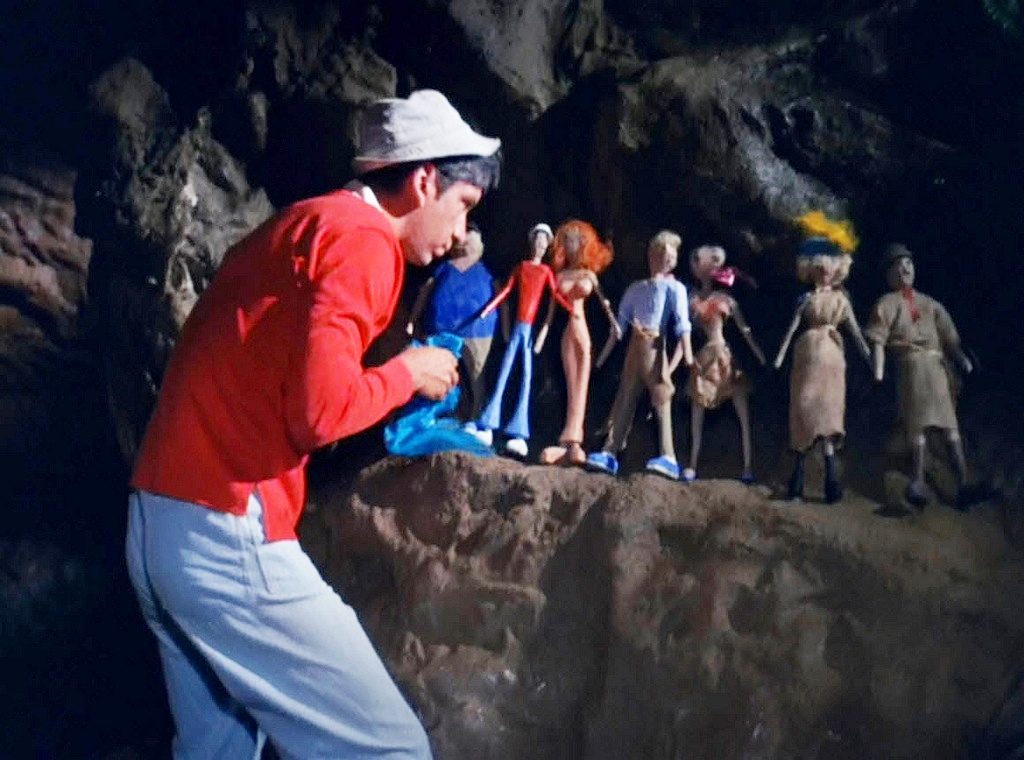
The witch doctor makes voodoo dolls of all seven castaways and begins to cast his spells by making Gilligan spin against his will, then everyone suffering a hot foot. The Professor naturally scoffs at the notion of voodoo, but his lost pen knife enables the witch doctor to transform him into a zombie, which meets with Mr. Howell's approval, as he describes a zombie to his wife: "you take five jiggers of rum and then some cooling ice!"
Ginger remembers seeing such wide staring eyes before: "I was entertaining a bunch of GIs in an army camp!" When she tries to free him by recreating her hula from NATIVE DANCERS FROM BALI-BALI all eyes are glued to her sinuous form, only to succeed in doing THE RAIN DANCERS FROM RANGO-RANGO, a downpour soaking the frozen zombie (at one point bongo drummer Gilligan nearly loses his place watching her shimmy and shake). Gilligan breaks the spell by recovering all the stolen items, making his own doll in the unseen witch doctor's image, and for once sticks it to him!

https://www.youtube.com/watch?v=1UqVaW_IlBk


The Witch Doctor is a native shaman from an unidentified tribe of natives on a nearby island. His true name is unknown, but he arrives on the island and uses dolls made to resemble the castaways and personal belongings to cast spells on them. He takes Gilligan's rabbit foot, the Skipper's hair, Mr. Howell's wallet, Mrs. Howell's lipstick, scarves from Ginger and Mary Ann and the Professor's pocket knife. Through these objects, he sticks pins in the castaways, bounces Gilligan around, burns their feet and finally places the Professor in a trance for mocking him, which suggests he understands English. Gilligan, however, retrieves the dolls and stolen possessions, breaking the spell on the Professor and using a needle to jab the Witch Doctor, driving him off the island. It is unknown if Hiruki of the nearby Papuan tribe was any relation to the Witch Doctor, who he resembled.


Possibly upset over the castaways disturbing burial grounds in a cave on the island, he torments them with Voodoo curses and entrances the Professor, who he may have believed to be their equivalent of a shaman. When Gilligan turns his spells on him, he flees the island by swimming out through the lagoon. 


..........................................................


Part Five, HEAD HUNTERS ARRIVE


Topsy-Turvy is the 78th episode of Gilligan's Island and the tenth episode of the third season. It aired November 14, 1966. in this episode the Castaways are menaced by invading warriors. 
The warriors are are believed to be headhunters from the either the 'Marubi' tribe or most likely the 'Watubi' tribe. The warriors announce their arrival by pounding on their war drums. The Professor seeks out a cave to hide everyone until they leave. Unfortunately, Gilligan runs straight into a tree, and the whack to his heads flips his vision upside-down. The Professor thinks he can fix his vision with the curative powers of the Captibora berry growing on the island, but Mary Ann is too afraid to look for them with the pounding drums from the jungle. However, Gilligan notices the sounds have stopped; unaware the head-hunters are still on the island despite their broken drum. Ginger and Mary Ann search the island for the berries unaware the head-hunters are still prowling around and trying to capture them.

One of them tries to attack Gilligan, but he is scared away by the approaching Howells. After the Professor creates extract from the berries, the berries succeed in flipping Gilligan's vision back, but it also doubles it so Gilligan sees two of everything. 


Headhunters land on the island pounding their war drums


The Headhunters Stalk Their Prey 

Fierce Marubi Headhunters Demonstrate Their Skill By Chopping Down A Palm Tree

The Professor meanwhile warns Gilligan his skewed vision might result in hallucinations, and when he starts seeing the head-hunters, he thinks they're hallucinations. However, the head-hunters start getting frustrated with their failed attempts to capture Gilligan. They capture both the Howells and the girls, and after the Professor fixes Gilligan's vision with water to dilute the strength of the berries, both he and the Skipper get captured. Gilligan flees into the jungle chased by one of the head-hunters, but realizing he's out-numbered, he returns with the Captibora extract to trick them into thinking they're out-numbered. He comes to rescue everyone pretending to drink the extract which the head-hunters take away from him to drink themselves. As the extract takes control, Gilligan frees everyone who appears as an army to the head-hunters, terrifying them off the island. Afterward, everyone is so appreciative of his clever heroism that they give him gifts. Mary Ann gives him a coconut cream pie, but Gilligan is so excited that he drinks the extract again so it looks like five pies. However, this makes it hard to eat the one; he pounds the table and causes the pie to smack the Skipper into the face.


"Topsy-Turvy" finds the castaways preparing to hide from invading head hunters, but when Gilligan bangs his head he sees everything upside down. Captibora berries can provide the antidote, but their unstable properties result in Gilligan seeing double! Meanwhile, there are three head hunters waiting to practice their deadly craft, each one just missing his intended target, until all but Gilligan are captured. The Captibora extract gives Gilligan the perfect opportunity to lure them into drinking, as the sight of 35 castaways forces them to flee in terror.


..........................................................


Part Six, THE KUPAKI


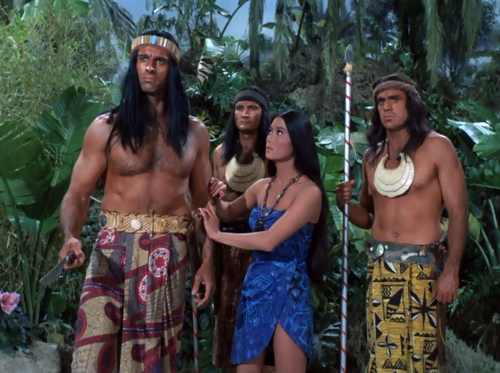
Kupaki Warrior 1

Kupaki Warrior 2

Kupaki Warrior 3

The next wave is an advance landing party of Kupaki warriors coming to visit their local sacred land on the island marked by a totem pole. Taking everyone captive, they are driven back by Gilligan posing as their long-dead king. Episode: High Man on the Totem Pole
While misdirected in the jungle and trying to find their way back to camp, the Skipper and Gilligan find a totem pole and show it to the Professor. At the top of it is a head that is a dead ringer for Gilligan, leading him to believe he is the descendant of a Kupaki headhunter. Unsure of his identity, he becomes obsessed with the likeness, both Ginger and the Howells trying to snap him out of it, but everything seems to remind him of it. 


When Gilligan tries eliminating the cause of his distress by chopping the head off the pole, the Skipper points out that hypocrisy of chopping off its head. Unsure of how to behave, Gilligan decides to leave camp, but the Professor challenges his fear by handing him an axe and offering his own head. Realizing he's not a headhunter, Gilligan tosses the axe out of the window. 

Meanwhile, real Kupaki warriors appear on the island and discover that someone has defaced the head of Mashuka, their divine king on the sacred pole and cry out for revenge. They're discovered by the Skipper and Professor trying to return the head to the totem pole. After the Kupaki capture the Howells, the Professor tries to rescue them by having Gilligan impersonate their dead king. While getting him ready, the Professor and the other castaways are taken captive. Gilligan is left alone to rescue everyone, but his fear and uncertainty of their language leaves them suspicious that he is Mashuka. When they try capturing him, Gilligan runs past the totem pole and stumbles behind it, knocking into view the missing head from the pole. 


Realizing they dishonored their divine ancestor, the Kupaki are terrified and flee the island in fear.


The following morning, Gilligan reveals he's repaired the totem pole, replacing the head up top with the likeness of Mr. Howell to take his turn as Mashuka.


The likeness of the great King Mashuka lies disrespectfully on the ground

Gilligan is left alone to rescue everyone,
but his fear and uncertainty of their language
 leaves them suspicious that he is Mashuka.
Gilligan dressed as the Kupaki King Mashuka


The Kupaki Totem Pole is a native artifact on the island that Gilligan and the Skipper discover in the jungle. The pole is highlighted on top by the face of Mashuka, the Kupaki headhunter-god.

.............................


.............................


Episode: Slave Girl

Slave Girl is the 94th episode of Gilligan's Island and the 26th episode of the Third Season. It aired on March 20, 1967.
When Gilligan saves a native woman named Kilani from drowning, she vows to be his slave for life, a tradition in her tribe. Gilligan tries to do his chores himself, but she comes and does them for him. Despite the fact Gilligan feels guilty over having her as a slave; the Girls and the Howells are intrigued. Mr. Howell wants the slave girl, but in order for him to claim her, Gilligan would have to be dead! Mr. Howell decides to fence Gilligan for her hand, faking Gilligan's death fencing as three more natives come looking for Kilani. 
Matoba tribe warrior 1
'Ugundi' warrior of the Matoba Tribe 


Matoba tribe warrior 2
The Professor translates that they are present to take back Kilani, and Ugundi, Kilani's suitor, will fight Mr. Howell to claim her. However, since Gilligan is still alive, she still belongs to him. The Skipper and the Professor once more try to fake Gilligan's death with the Howell's briefly misunderstanding their intentions. The natives, however, convinced that Gilligan is dead; decide to cremate his remains as per their customs. This leaves Ginger to stall for time with a dance until Gilligan can awaken, an act which terrifies the natives into fleeing the island believing he is a great fire-god.

The Castaways also make peaceful relations with Kilani of the Matoba and her tribe after Gilligan rescues her from the lagoon. Men from Kilani's tribe, Ugundi and two others, come looking for her and revere Gilligan so much they consider him a god after he seemingly dies, but after he wakes up, they flee the island in a panic.


After Gilligan saves a beautiful native girl from drowning, she vows to be his slave forever.
Ugundi is a warrior from the Matoba tribe. He appears on the island accompanied by two other Matoba tribe warriors searching for his bride Kilani. He challenges Gilligan to a duel to the death


"Slave Girl," as played by Midori, is Kalani, a pretty Matoba girl saved from drowning by Gilligan, her native customs demanding that she remain his slave for life. The other castaways offer bids for her services but she refuses to serve anyone else but Gilligan. Kalani insists on doing all of Gilligan's chores until he finally asks the Professor what can be done. The answer is not a healthy one, a duel to the death, basically Gilligan's! Mr. Howell makes an offer he can't refuse, the staged result putting Kalani in the victor's employ, only for a new challenger appearing in fellow Matoba warrior Ugundi (Michael Forest), who seeks to claim Kalani for himself.
A chance remark gives the Professor the idea to put Gilligan into a cataleptic state that will simulate death


Ginger and the castaways to stall for time for Gilligan to wake from the effects of the curare. 

Ugundi insists on a Matoba funeral, which requires the corpse to be set aflame!

Gilligan awakes from "being dead"
He realizes that he is on fire!!!

The Matoba consider Gilligan a god after he seemingly dies, but after he wakes up

Just after being lit on fire, Gilligan finally awakes, terrifying Ugundi and Kilani from the island.


Ugundi to comes looking for Kilani and reclaim her. With Gilligan still alive, Kilani still belongs to him, and Ugundi wants to fight Gilligan to reclaim her
Kilani is a lovely Native maiden who canoes into the lagoon of the island. After her canoe over-turns, she is rescued and revived by Gilligan, to whom she now vows a life debt. She follows Gilligan around serving him and doing his chores, much to the jealousy of the female castaways and the Howells. 


.

.............................


Part 6, KING KALIWANI; THE PAPUAN TRIBE


While Gilligan is working on a SOS sail on the beach in the lagoon, King Kaliwani, a native chief with endless titles, comes to the island looking for a beautiful girl he calls a "White Goddess."


The girls run in fear from him and his warriors, but the Professor finds a lighter in the chief's out-rigger canoe that proves he has contact with the outside world and can get them rescued. Now, Mary Ann, Ginger and Mrs. Howell are competing against one another until they find out the "winner" is to be thrown into an active volcano! but Gilligan manages to escape on his own, leaving his disguise behind in the Girl's Hut. When the superstitious king discovers the wig and clothing, he becomes terrified, fleeing the island with his warriors.


The men stand their ground to defend the girls, but Kaliwani and his men come back after departing a bit less friendly; they fire a deadly blow dart that kills a potted plant.
  
Unfortunately, the only one who can successfully pass as a woman is Gilligan, who is completely indignant at the turn of events. Named "Gilliana," Gilligan learns that Kaliwani wants to keep him as a bride for himself and throw a dummy into the volcano. Mr. Howell and the girls try saving Gilligan with magic acts and USO acts
Faced with an unavoidable impasse, the Professor and the Skipper however scheme to trick the Chief into settling for one of them disguised as a woman.

The stunning white goddess, Mr. Howell

The equally glamorous white goddess. Professor


"Gilligan, the Goddess" was never intended to be the final episode, the series having been renewed for a fourth season, but the apparent demise of the long running GUNSMOKE was too much for CBS to contemplate, so its return to the fall schedule meant the loss of a show they never really appreciated. Judging by the finale there's no reason to believe that another season wouldn't have been just fine, the third year actually improving on the second.

Stanley Adams guest stars as King Kaliwani, civilized native chief in search of a white goddess to come to his island for a wedding ceremony.

All three women are ready to play the part, until they learn that the groom is a volcano, into which the goddess will be thrown!

All four men decide to dress up and play goddess in order to spare the ladies, but only Gilligan looks 'positively ravishing,' according to Mr. Howell! Unfortunately, it isn't long before the amorous king laments having 33 wives who don't understand him, making the moves on a perplexed Gilligan.
Perhaps best remembered for his turn on STAR TREK's "The Trouble with Tribbles," Stanley Adams manages to broker a full complement of laughs with various asides with Two guards (Mickey Morton and Robert Swimmer)


The Great King Kaliwani


King Kaliwani is the chief of a nearby Papuan native tribe on an island to the West, he also has the titles of Emperor of Eternal Night, Knight of Eternal Day, Seeker of Eternal Truth, Lord of Eternal Eternities and Keeper of the Eternal Flame.
His introduction a classic - Emperor of eternal night, Knight of eternal day, Seeker of eternal truth, Lord of eternal eternities, Keeper of eternal flame. (Plus one can eternal lighting fluid!)


The Professor finds his 'eternal flame,' actually a cigarette lighter, and learns that the King's island occasionally is visited by a ship.


Kalawani arrives on the island by outrigger canoe along with two other Papua island natives in search of a "White Goddess," a ritual volcano sacrifice on his island. Although initially opposed to the idea, Ginger, Mary Ann and Mrs. Howell are willing to fill the role until they hear the purpose. Eager to make it to Kaliwani's island for the ships, the Professor passes off Gilligan as a woman, but the king is so captivated with him that he opts to keep Gilligan for himself. The Castaways try saving him, but Gilligan distracts him to escape on his own, leaving behind his disguise and completely terrifying King Kaliwani to flee the island with his guards.

..........................................................